Your laptop is descended from a loom, and it has never got over it
We called the company Binary & Thread because it sounded good. Then we looked into it, and it turns out we were just being accurate, two hundred years late.
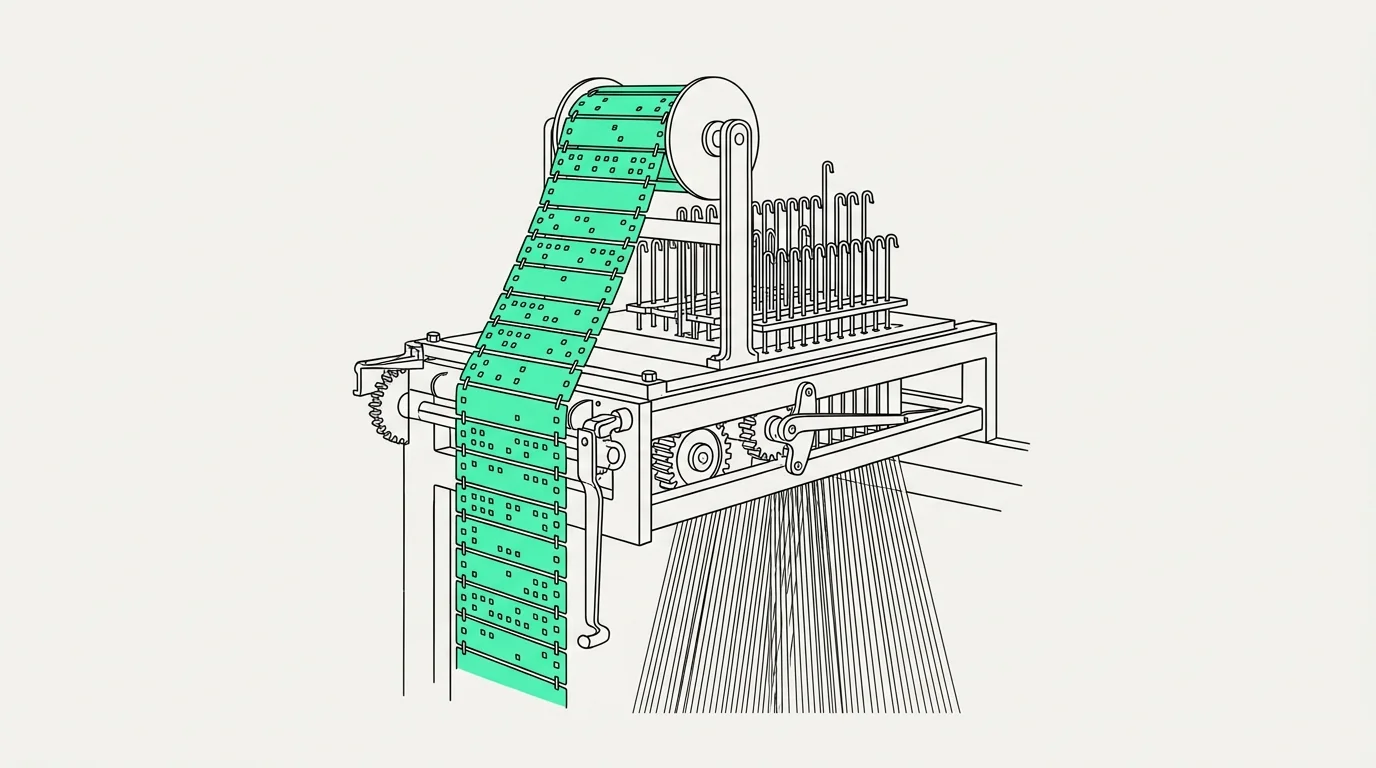
The direct ancestor of the machine you are reading this on is a device for making patterned silk. I appreciate that sounds like something a clothing company would say. It is also true, it has dates, and by the end of this you will be slightly annoyed that nobody told you sooner.
In 1804 a Lyon silk merchant called Joseph-Marie Jacquard bolted a card reader onto a loom. Punched cards on a chain, meaning stiff rectangles with holes in a grid, fed through in order, one card per row of the pattern. Hole means lift, no hole means do not. Repeat a few thousand times and you have a tablecloth.
Quick recap for anyone who has not thought about weaving since school: a loom holds a load of threads stretched tight, called the warp, and you make a pattern by picking which ones to lift before each pass. Figured silk means the pattern is woven in rather than printed on top, which is why it was expensive, and why every row is a decision. Thousands of decisions per tablecloth. You can see the problem.
What he had actually invented, apparently without dwelling on it, was the separation of program from machine. Before Jacquard, the pattern lived in a master weaver's memory and in the arms of a child known as a draw-boy, whose whole job was to sit inside the loom and lift the right threads when told. So Jacquard did not automate the weaver. He automated the kid.
After Jacquard, the pattern is a physical object you can copy, lend, sell or nick. That is software. That is all software has ever been. It just happened to be invented by a man trying to make expensive tablecloths less expensive.
Now the flex. In 1839 somebody wove a portrait of Jacquard in silk. Twenty-four thousand cards, each with over a thousand hole positions. People still mistake it for an engraving.
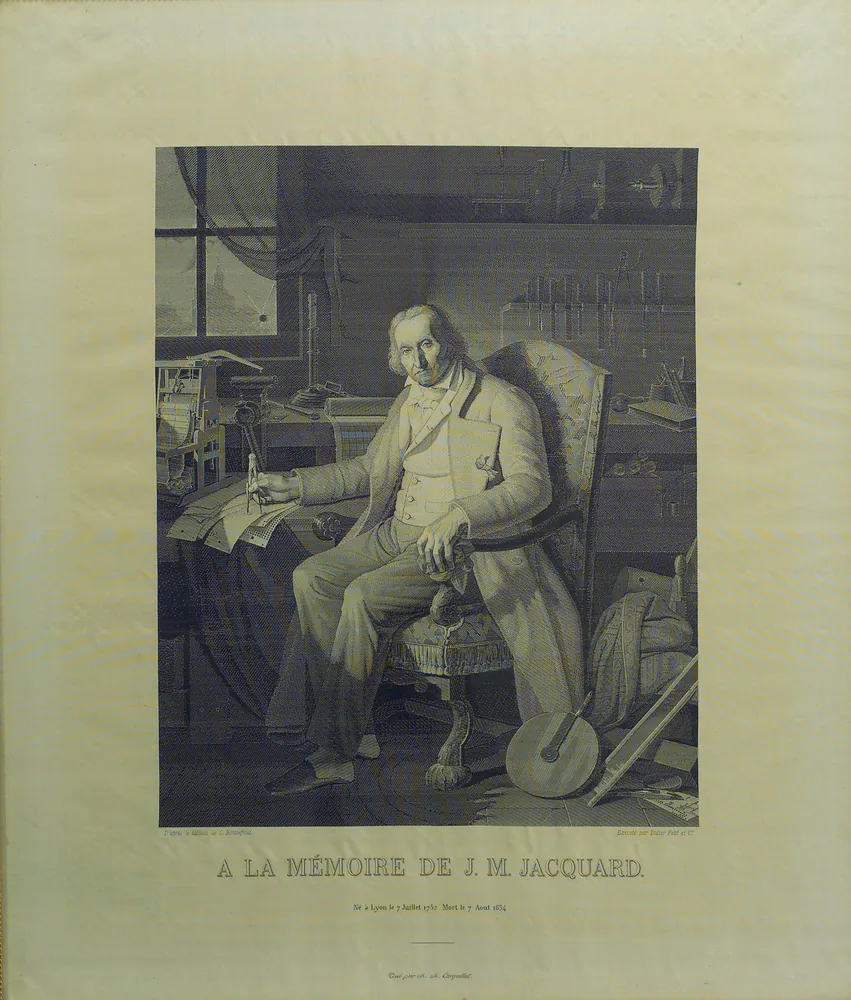
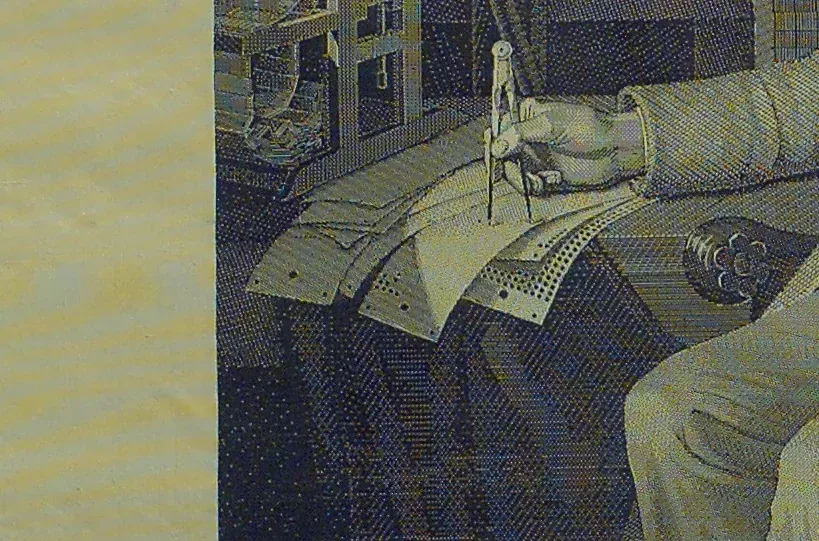
Charles Babbage owned a copy and hung it in his drawing room, which for a man who spent forty years designing calculating engines and finishing precisely none of them is a bold choice of wall art. Nothing says “I ship” quite like displaying someone else’s completed project.
Babbage helped himself to the card mechanism for his Analytical Engine, did not build it, obviously, and the whole thing survives mostly through notes published in 1843 by Ada Lovelace. Lovelace was a mathematician who translated an Italian write-up of Babbage’s machine and then bolted on commentary four times longer than the original document, which remains the most relatable behaviour anyone in this article displays. Her notes are the first published description of programming a computer. They contain this:
Everyone quotes that as a charming metaphor. It is not a metaphor. She had a working loom that followed instructions on punched cards, and a paper machine that would follow instructions on punched cards, and she wrote down what she was looking at. Calling it a simile is like calling “this dog is a mammal” a lovely turn of phrase.
Then, in the same unbothered tone, she adds that the numbers do not have to be numbers, they can represent anything you can encode. That is the entire concept of general-purpose computing, dropped into a footnote, by a woman annotating someone else’s unfinished hardware.
The cards, meanwhile, are just getting started. 1890: the American census is a shambles, the previous one took nearly ten years to count and Americans keep being born at an inconsiderate rate. Herman Hollerith, a young statistician who worked on that census and evidently never emotionally recovered, punches the answers onto cards and builds a machine to tally them. Tabulating Machine Company, 1896. Merges upward in 1911. Renames itself in 1924 as International Business Machines.
Tabulating, since the word has gone vague, meant counting and cross-counting by hand. How many people, what age, which state, which job, every combination, millions of forms, all of it done by human beings at desks. Hollerith read the holes instead and turned a decade into a season, which is the first recorded instance of somebody solving a data problem by refusing to look at the data.
Loom to IBM in four hops, and the thing that goes the whole way is a bit of card with holes in it whose original job was telling a hook when to go up.
Finally, the thing we named the piece after. A sampler is that stitched alphabet you have seen in an antique shop and assumed was a Victorian girl’s craft project. It was her reference manual. Every letter, every stitch she could do, recorded in thread so she could look it up. An indexed instruction set, on a wall, about a century before either of those words existed.
And nobody framed one until the technique was thoroughly dead, which is precisely the respect every good README has ever received.
So: we make a piece called The Sampler, our name is Binary & Thread, and it turns out we were not being clever at all. We were being late to a naming decision somebody else had already made, in silk, before electricity.
Where this comes from
- primaryAda Lovelace, Note A to her translation of Menabrea, 1843The “weaves algebraical patterns” line, and that the notes are the first published account of programming.
- primaryMetropolitan Museum of Art, object 222531The 1839 woven portrait: maker, date, medium, and its public-domain status.
- secondaryScience and Industry Museum, “Programming patterns: the story of the Jacquard loom”Jacquard 1804, and the separation of instructions from the machine.
- secondarySmithsonian, “From Herman Hollerith to IBM”The 1890 census, Tabulating Machine Company 1896, the 1911 merger, and the 1924 rename to IBM.
- secondaryColumbia University, “The Jacquard Loom”The line from Jacquard through Babbage to Hollerith and the punched-card era.